

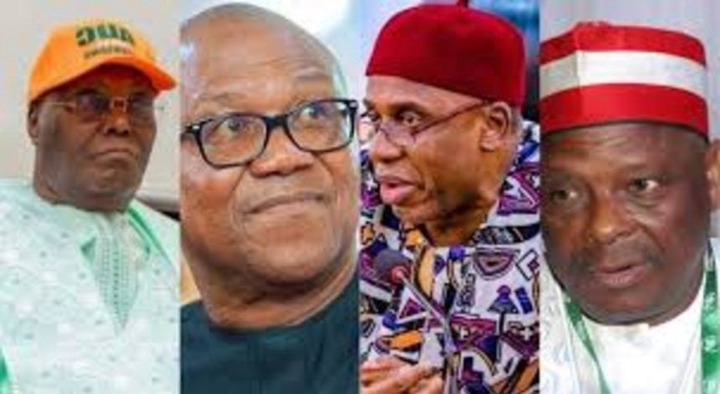
As preparations gradually intensify toward Nigeria’s 2027 presidential election, the African Democratic Congress (ADC) is increasingly being viewed as a potential convergence point for some of the country’s most influential opposition politicians, including Atiku Abubakar, Peter Obi, and Rabiu Musa Kwankwaso.
According to a report published by the Nigerian Tribune on Monday, April 27, 2026, discussions around opposition realignment have gained momentum, with the ADC emerging as a possible platform capable of hosting a broad coalition aimed at challenging President Bola Ahmed Tinubu’s bid for re-election.
Collectively, the political weight of Atiku Abubakar, Peter Obi, and Rabiu Musa Kwankwaso is seen by analysts as a significant factor that could reshape the electoral contest if properly coordinated.
Their combined voter appeal from the 2023 elections is often cited by supporters of the coalition idea as evidence that a unified opposition could mount a serious challenge to the ruling All Progressives Congress (APC).
However, political observers note that electoral success in Nigeria is shaped by far more than aggregated vote totals.
Factors such as regional loyalty, religious identity, zoning expectations, political trust, and grassroots mobilisation continue to play decisive roles in determining election outcomes.
Within the emerging opposition calculations, other prominent figures such as Rotimi Amaechi and Aminu Waziri Tambuwal are also being mentioned as potential stakeholders in a broader alliance.
Their inclusion adds both strategic depth and additional complexity to the negotiations, as each figure brings different strengths and political limitations to the table.
The ADC’s central argument is built around the idea that opposition votes from the 2023 presidential election, when combined, surpassed those of the incumbent president. Supporters of this position believe that a unified front could translate numerical strength into electoral victory in 2027.
However, sustaining such a coalition presents its own challenges. Analysts caution that forming an alliance is often easier than maintaining unity after the selection of a single presidential candidate, especially in a politically diverse environment like Nigeria’s.
Each of the major opposition figures brings distinct political advantages. Atiku Abubakar is widely regarded as having one of the most extensive political networks in the country, with decades of experience navigating party structures at the highest level.
Nevertheless, repeated unsuccessful presidential bids have created a sense of fatigue among some segments of the electorate, raising questions about his ability to mobilise fresh support, particularly among younger voters.
Peter Obi continues to enjoy strong backing among urban populations and youth demographics, where his message of reform and governance change resonates strongly. Despite this, political analysts point out that his acceptance within traditional political establishments remains uncertain in several regions where established power structures remain influential.
Rabiu Musa Kwankwaso maintains a solid and loyal support base, particularly in Kano State and parts of the North-West. His influence in those areas is considered formidable, although his appeal beyond those strongholds is viewed as less consistent compared to other leading contenders.
Rotimi Amaechi brings extensive experience across both legislative and executive roles, having operated within different political camps over the years. However, his outspoken political style and the absence of a clearly defined nationwide grassroots base may limit his broader electoral reach.
Aminu Waziri Tambuwal is often described as a strategic political operator, known for careful negotiation and behind-the-scenes influence. While respected within political circles, he does not currently command the same level of mass public mobilisation as some of his contemporaries.