

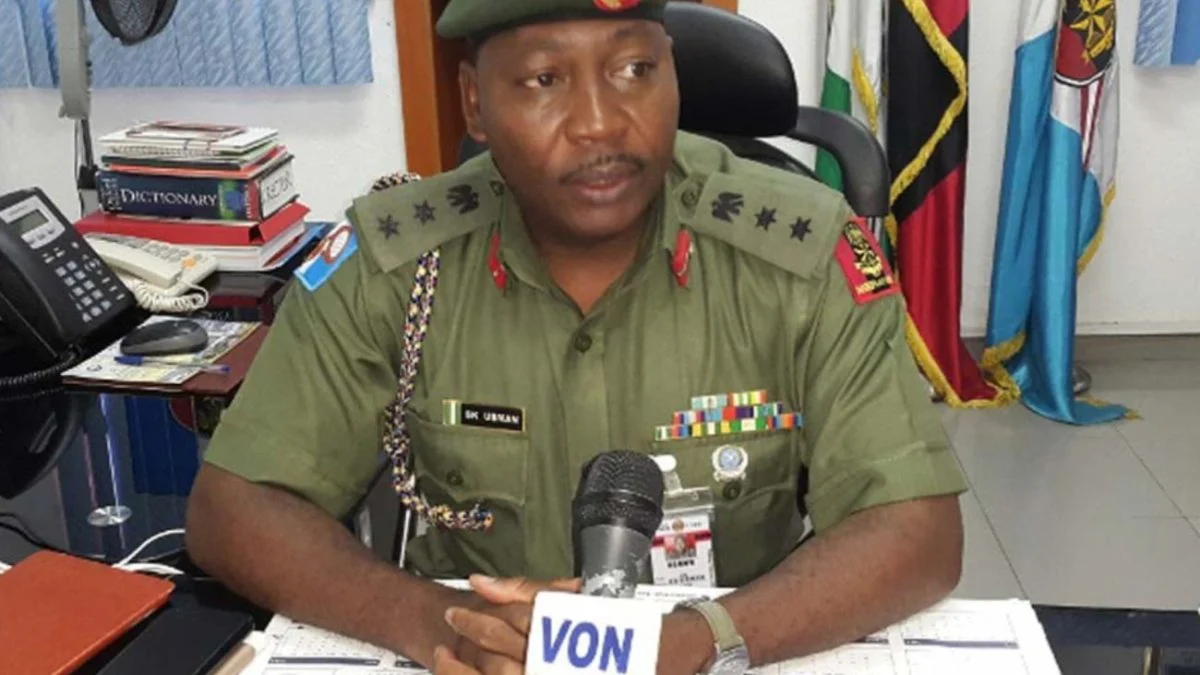
Former Director of Army Public Relations, Sani Usman, has said Nigeria can significantly weaken terrorist and bandit groups by deploying modern technology and strengthening intelligence gathering across the country.
Usman stated this during an appearance on Channels Television’s Sunday Politics, where he spoke on the growing security challenges facing the nation and the role intelligence plays in combating violent crimes.
The retired military officer said security agencies must take advantage of technological tools to track criminal networks, identify suspects early, and prevent attacks before they occur.
According to him, technology has become an essential component of modern warfare and internal security operations around the world.
Speaking on the activities of terrorists and bandits, Usman noted that many of the individuals who eventually become leaders of criminal groups often show signs of violent behaviour or criminal tendencies long before they rise to prominence.
He argued that a more effective system backed by technology would help security agencies identify such threats early and stop them before they become major security risks.
According to him, “All the leadership of the banditry and the kingpins of terrorists, if you look at their history, they have exhibited some form of violent extremism right from the beginning, or they have this tendency of criminality over time, and the system was unable to check them too.
“Technology helps in the sense that even if a criminal has a tendency of committing crime, the system will eventually catch up with him.
“And somehow people will have a second thought because you know that you can’t hide; there is a limit to which you can hide because you can’t go far.”
Usman stressed that intelligence remains one of the most critical weapons in the fight against terrorism. He said security agencies require accurate and timely information to disrupt criminal operations and dismantle the networks that support violent groups.
He explained that modern surveillance systems, digital databases, biometric technology, communication monitoring, and data analysis tools can help authorities identify suspicious movements and track wanted individuals across different parts of the country.
The former Army spokesman also suggested that stronger collaboration among security agencies would improve the effectiveness of intelligence-driven operations.
He noted that information sharing between military formations, intelligence agencies, the police, and other security institutions is necessary to stay ahead of criminal elements.
Nigeria has battled terrorism, insurgency, kidnapping, and banditry for more than a decade. While security forces have recorded successes in several operations, attacks by armed groups continue to pose a major challenge in parts of the North-East, North-West, and North-Central regions.
Usman maintained that criminals often exploit weaknesses within existing systems to evade detection. He said technology can close many of those gaps and make it more difficult for terrorists, kidnappers, and bandits to operate freely.
He added that beyond military action, intelligence gathering must be strengthened at both the community and national levels.
According to him, local communities can play a key role by providing useful information to security agencies, especially when supported by effective technological systems that allow for quick response and analysis.
Nonetheless, the Federal Government has continued to assure Nigerians that measures are being implemented to improve security operations and protect lives and property.
